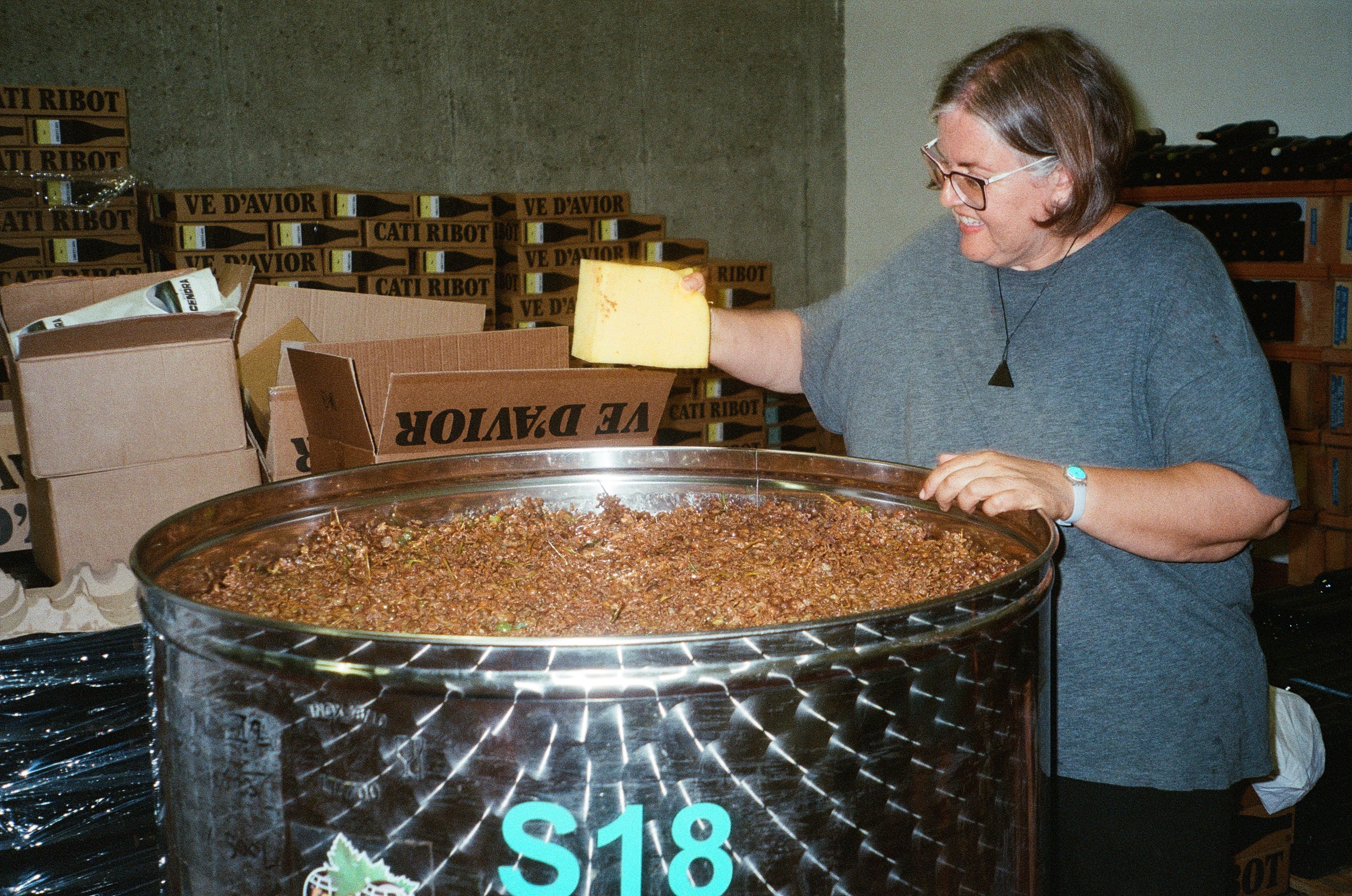
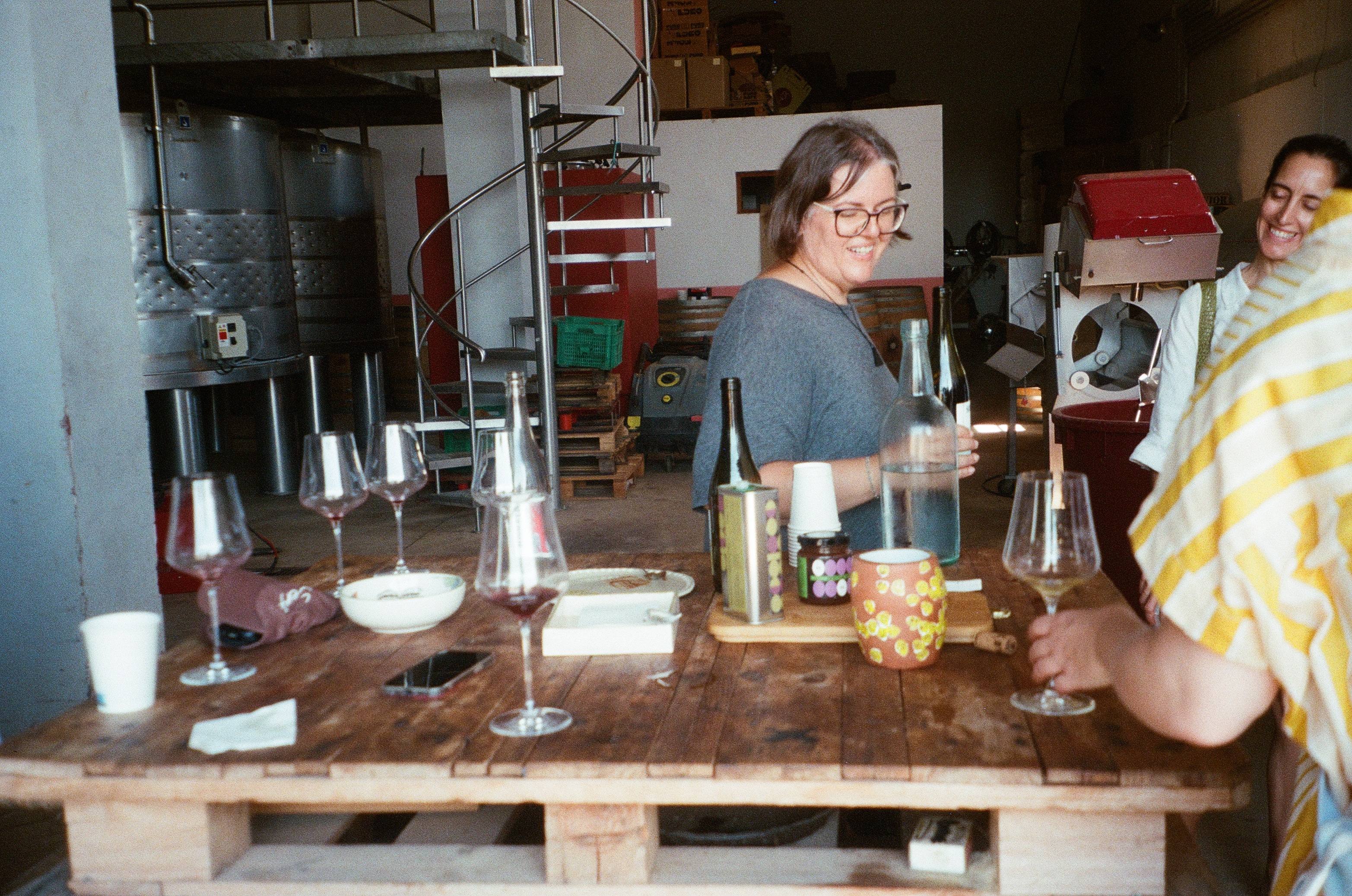
Cati welcomes me —and anyone, really— into her cellar in Santa Margalida, Mallorca, with open arms and wine in hand. There's a beautiful painting, portraying her family, made by her daughter, Ne. I love the toplessness of it all, the wines, the colors, the floating heart, the moon and the sun —an eclipse, maybe— and then another sun, because I guess it can never be sunny enough. Somehow, this painting captures the warmth you feel when talking to Cati. Such a humble, warm human. I call her friend now. Ne’s artistic talent also makes its way onto some of Cati Ribot’s wine bottles, like Bosquet.
How did your relationship with the land and with wine begin?
The vineyard found me. I didn’t go looking for it.
I’m the third generation of winegrowers in my family. My grandparents started growing vines, and then my father and mother carried on. The winery was my father’s project—well, it’s a family project, but he was the one who founded it.
In the vineyard, we started planting international varieties: Merlot, Grenache and Chardonnay. In the 1990s, they were being planted everywhere. Later, we created an experimental plot with lesser-known Mallorcan varieties like Escursac, Gargamussa, Giró Negre… that was around 2006. But back then, here at the winery, we were making more “technological” wines with international varieties.
I worked here because I was an only child. I didn’t have any siblings or cousins, so it felt almost like something imposed on me. And subconsciously, I was also doing it to please my father. There was no one else, so to me it was simply a job, not a passion. I found it exhausting, and it was very hard for me to keep going because I didn’t enjoy it. I never drank wine—I always drank beer—because I genuinely didn’t like what I was doing.
Later, in 2008 and 2009, I went to Catalonia, where I trained as a sommelier. That’s where I met a great friend, Joan Rubió, who makes wine in the Penedès, and I tasted many low-intervention wines.
I needed to leave Mallorca to really see what I was doing and realize that it wasn’t my path. That’s when things started to change. That’s when things started to change. In 2010, we switched the vineyard to organic farming, and by around 2012 all of our vineyards were certified organic.
By paying attention to these lesser-known Mallorcan varieties, I realized that those wines did give meaning to my life. They stirred something in me, something that made me feel alive. I understood that I could create my own path by making wines that were more sincere, more honest—wines through which I could create something real.
Over the course of several years, we pulled out all the Merlot and Chardonnay and planted Giró Ros, Prensal Blanc, Malvasia and Escursac.
I started making low-intervention wines in 2014. I took different courses and completed a master’s degree in Viticulture and Oenology. In the middle of all that learning, I adopted a little girl on my own. I’m a single mother.
Is there a connection between the process you were going through and your decision to adopt?
It was a calling, an inner calling.
I had never pictured myself giving birth. There are things you just don’t see for yourself, and I would read stories about India that really touched me. I’m a very intuitive person, and I listen to myself. In the end, you need to stop and listen to what’s inside you, and express it—let it come out.
For me, it was India that spoke to me. One day, I was talking to a friend and telling her about my desire to adopt, and she said, “What? What are you waiting for? Life is passing by!” On April 5th that year, when I turned 40, I started the adoption process. It took two years, and then I went to bring her home. That was eight years ago.
By listening to yourself, you began to forge your own path...
Yes, and then in 2014 I started making low-intervention wines. I released a wine made with Giró Ros and Prensal Blanc, and when I presented it at a wine fair in Palma, it was heavily criticized. At the time, wines in Mallorca tended to have a higher alcohol content—13%, 13.5%—so wines at 11.5% challenged what people were used to. A journalist even came up to me and said that the wine didn’t represent Mallorca. But to me, it did represent Mallorca, because it was made from two local varieties.
At that first fair, we didn’t sell anything because, of course, our market was Mallorcan and people didn’t understand it. But I was happy.
You believed in it?
I believed it was the right path, and little by little I kept making that wine and selling it here at the winery. Years later, in 2019, I said, “We need to go further,” and that’s when I created Ve d’Avior. It’s a Mallorcan expression that has almost fallen out of use; there are people in the city who don’t even know what it means. It means “it comes from long ago.” These are wines made with old Mallorcan varieties, the way wine was made in the past, with nothing added. That’s where the project gets its name.
My grandfather made wine, and his wine was really bad. He would ferment it in a stone vat and it would immediately go completely off track. We do the same thing, but we guide the process, with the knowledge we have. We start the fermentation outside, and when the temperature rises, we move it into the cold room and keep guiding it along.
Going back to that fair, where the wines weren’t particularly well received, do you think the fact that natural wines didn’t have the recognition they do today played a role?
Yes. Twelve years ago, wines tended to be higher in alcohol, with more body and more volume. And to many people, mine didn’t meet those standards. It wasn’t like the others; they felt it didn’t represent the island.
To me, it did. It was something very honest, fresh and expressive. It said a lot. It was the first wine I made that really struck a chord with me. Making that wine moved me because it truly expressed something, and there was truth in it.
When did you start to notice a change in how other people perceived your wines?
In Mallorca, that change is only really starting now. But when I first started the project, there were importers from abroad who were interested. The first was an importer from Berlin who tasted the wines and said he wanted to buy them. After that, people also started reaching out to me through Instagram.
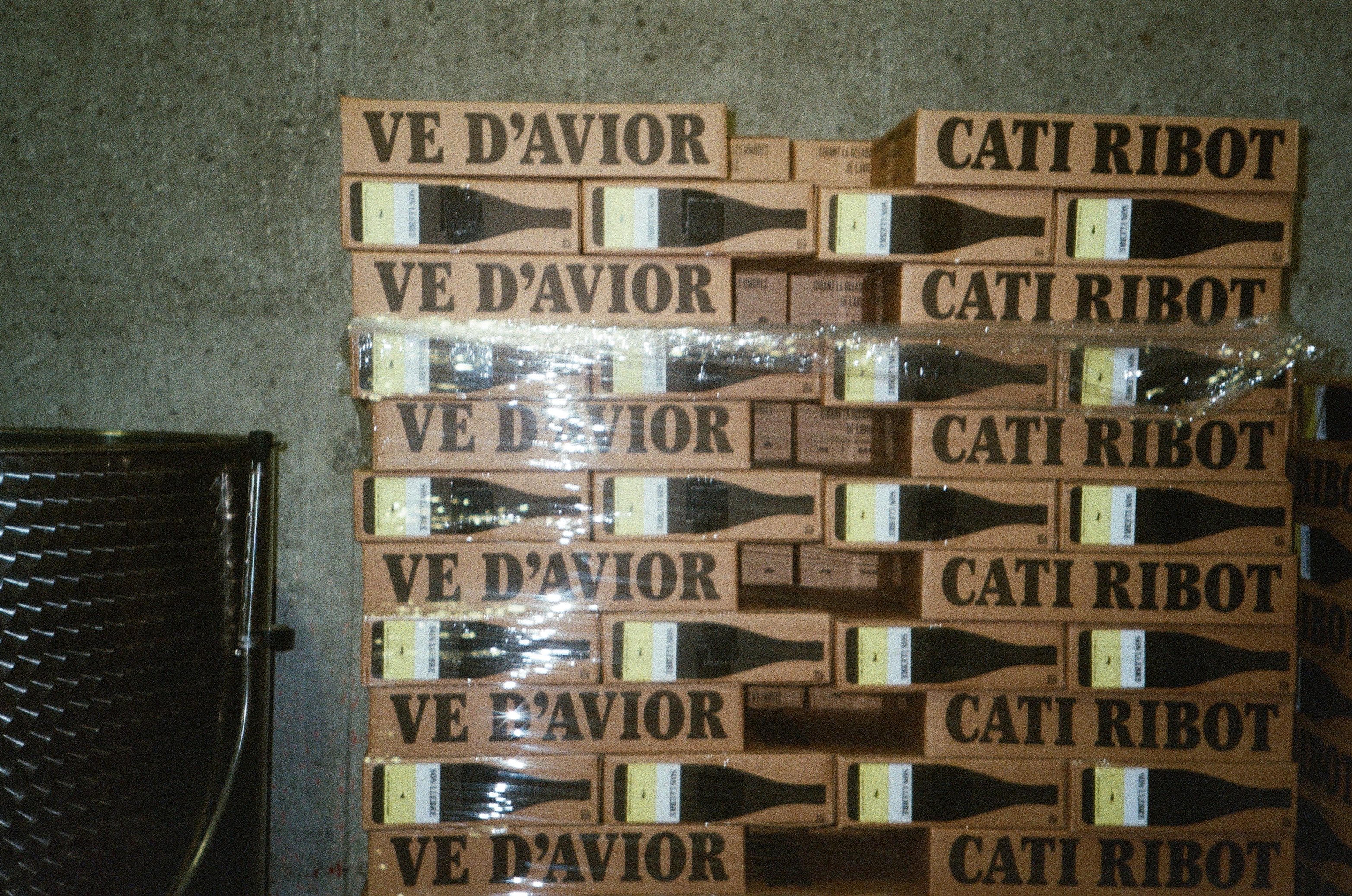
I started with 5,000 bottles, which sold very quickly, and now we produce between 25,000 and 30,000 bottles. They’re sold in different countries…
I’ve seen your wines in New York!
Yes, although our biggest markets are Catalonia and Madrid. Then Mallorca, the US, England, Germany, Switzerland, Belgium…
Is Son Llebre an inherited name, or one you came up with yourself?
It's the name of the estate, our estate is called Son Llebre. We make Son Llebre Blanc and Son Llebre Negre, Escambuix, which is a rosé, Malvasia and Escursac, which are varietal wines, as well as the sparkling wines.
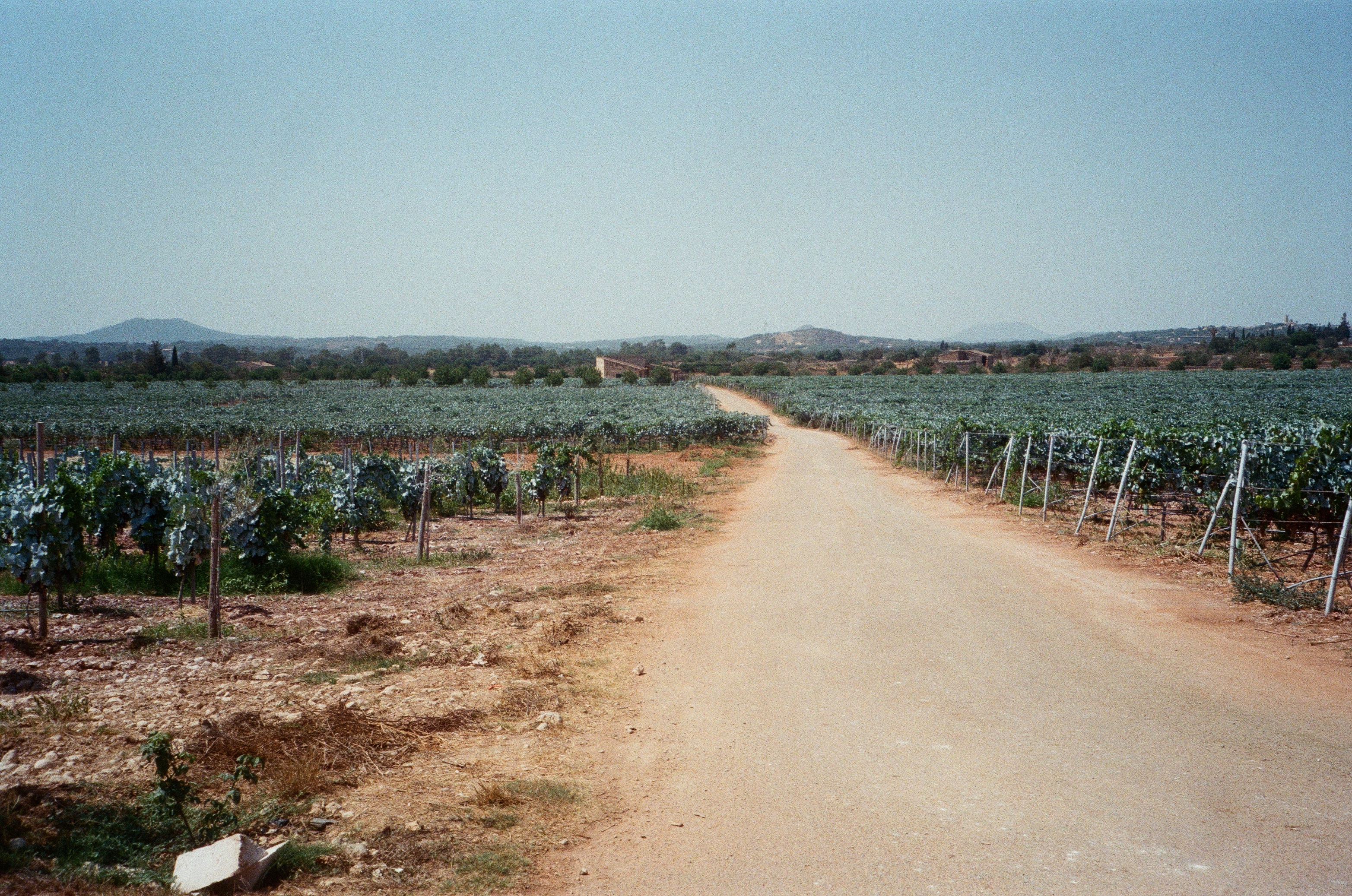
We have 12 hectares on the estate, and the soil is a clay loam, with a significant amount of clay. Eighty percent of what we grow are local varieties, while the remaining 20% is still Cabernet and Syrah. We’ve kept them because the founding partner deserves to have his place. I don’t want him to feel pushed aside, because without him we wouldn’t be here. We still make around 5,000 liters each year of the wine from the original family project my parents started.
In your day-to-day life, you’re constantly in contact with the land. What is it like to live with that direct connection and dependence—something we tend to forget in the routines of city life?
Last year we had a severe green leafhopper infestation. It’s a pest that stops the grapes from ripening. It really puts you to the test: how far are you willing to go to make a good wine? We had to buy grapes, to work with one variety and then another. With the grapes we couldn’t harvest because they simply wouldn’t ripen, we made grape jam. And in the end, you say… “My God, we did it!”
No matter what, come what may, it has to happen.
A lot of people come to visit you.
Yes. Saturdays are the only days we’re open, and people always come. We get such a warm response, and I’m very happy about that. This is what we have, this is our heritage: the varieties that come from here. And every year, we try to do the very best we can with them, to share them and show them in an honest way. We have to be proud of our varieties.
They have a long growing cycle, they’re lower in alcohol and not very acidic, and perhaps they don’t have great aging potential—but they’re ours, they’re from here. And if someone comes to Mallorca, they should taste them. This is the Mallorca we need to show.
Does each wine you make have its own “formula” that you repeat every year?
Natural wines are never exactly the same because we don’t add anything, so you have to take the vintage into account. Last year, because of the green leafhopper infestation, our wines had a lower alcohol content. This year, it may be higher because it’s been very warm. So it depends. They follow a certain direction, but it’s not like a classic Rioja, where you follow a recipe.
Are you planning to make any new wines?
With wine, you can’t really plan. Cambuix was born in 2020, and before the harvest, we had no idea it was going to exist. We had a hailstorm and the grapes were damaged, so we decided to pick the best ones and make a rosé. That’s how it came about. Of course, you start with a plan, but you have to stay open to change.
I’ve been making wine for 22 years now, and not once have things gone according to plan. You keep going, but in the end, things happen.
How does it affect you to be so dependent on the weather? If you’re at home and suddenly see a downpour, what do you feel?
I get nervous, very nervous. But I’ve always watched my father and my grandfather take it all in stride. The land is a great teacher, because you really have to be open and prepared —even though we never truly are— for anything to happen at any moment, just like in life. You say, “If everything goes well, I’ll go there, or I’ll do this,” but then anything can happen.
I’ve always seen that my grandfather and my father had really learned to accept losing. The vineyard is about winning and losing, and we have to be prepared to lose. Like Cambuix, which was something built out of destruction: after a disaster came a rosé that we still make every year.
What does Cambuix mean?
It's a Mallorcan word that means “messy hair.” For example, when you wake up in the morning and your hair is all tousled and sticking out, people say, “Oh, what a cambuix you’ve got!”
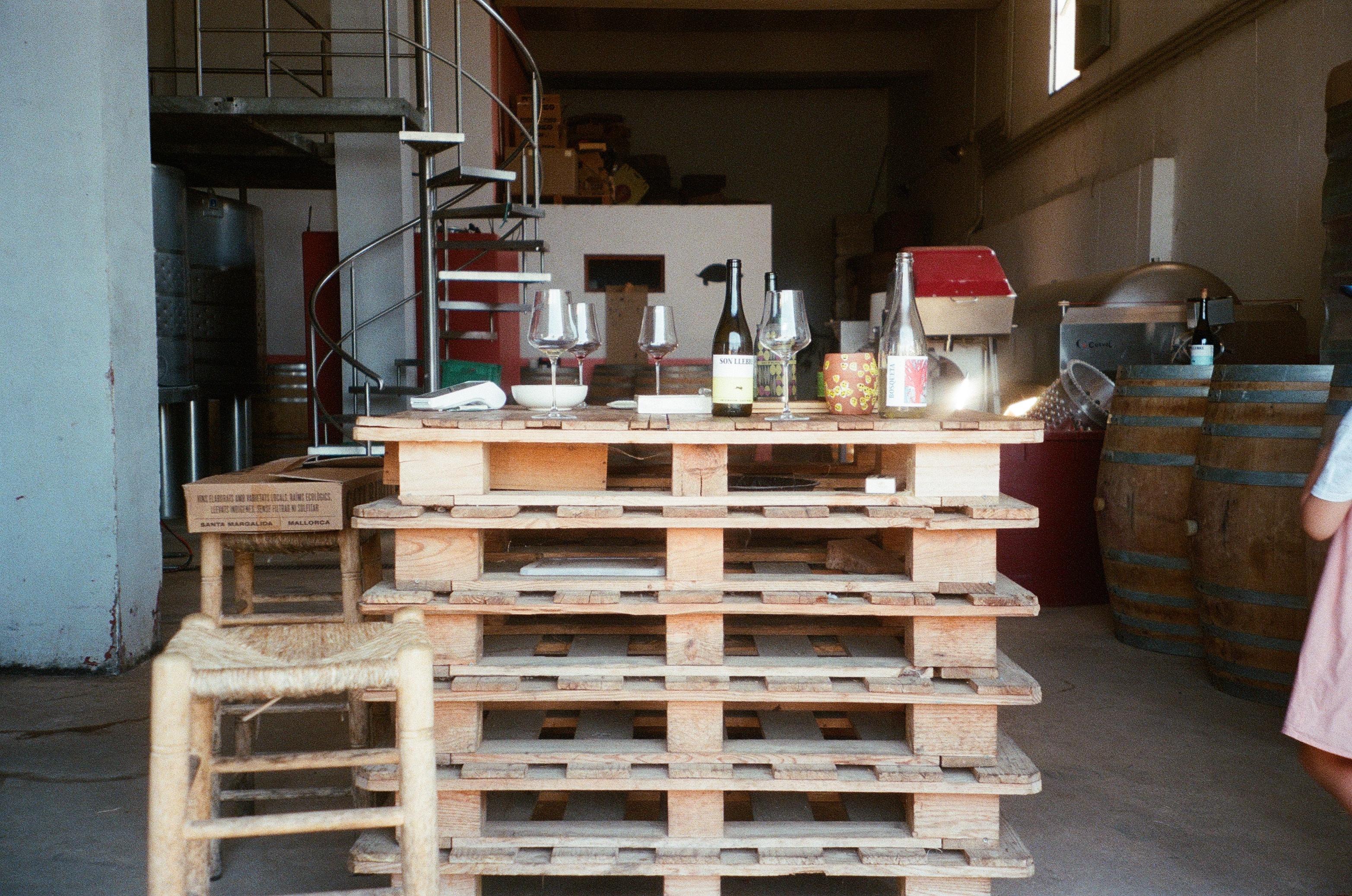
I always end with the same question: what woman inspires you and do you think deserves our attention?
My mother.
If you went to Santa Margalida right now and asked the older people in the main square, “Who is the hardest-working woman in town?”, I can assure you they’d say, “Catalina de la plaça,” because we have a house there. And that’s my mother.
My grandmother, her mother-in-law, used to tell me, “Your mother has only one flaw: she works too hard.” And maybe that’s true, but she’s a woman who, because of the circumstances life has put her through, hasn’t had it easy, and she is tireless. She can find a solution to anything; she never lets you give up. She’s very brave and hardworking. My mother.
And really, I would say all the women in my family. My grandmother became paralyzed at 25, and even in a wheelchair, every day she would make dinner for seven people, sweep and mop the entire house.
I’ve seen women who work incredibly hard. They live with both courage and fear. And because of that, fear drives me forward.
I go, with my fears, but I go.