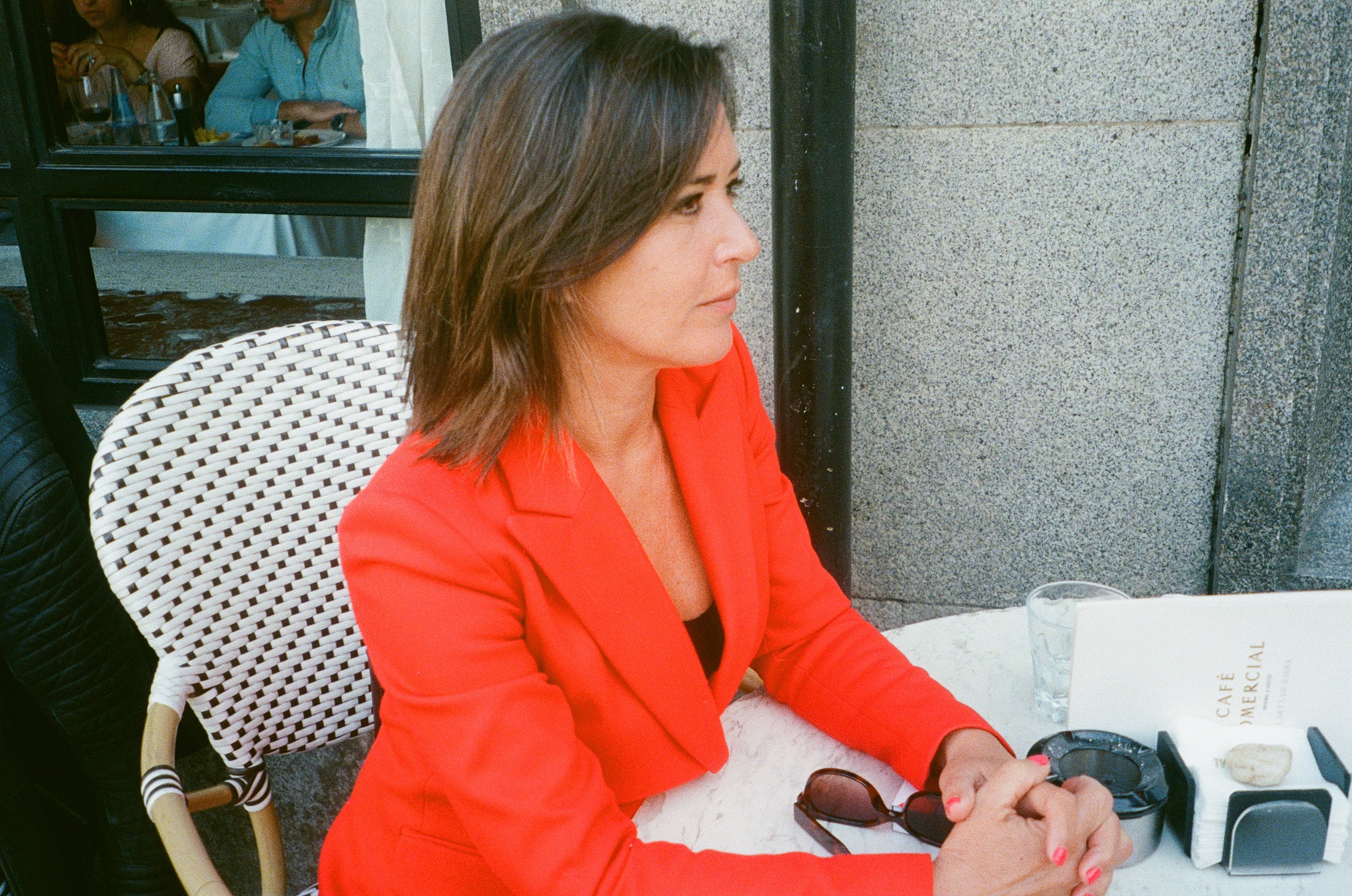
We live in a time of information overload. But there was a time when the evening news was where people turned to make sense of the world. If you had the power to decide the running order of the country's most-watched news programme, which stories or issues would you choose to cover?
Well, right now, the United States and everything that's happening with those infamous immigration patrols. Epstein, I don't understand why it's not on every front page, every single day. And violence against women, gender-based violence. The figures are chilling: so far this year in Spain, the numbers have reached record highs.
—Indeed. As I transcribe this interview, a 33-year-old woman has been stabbed to death by her former partner. The man, who had been arrested the previous day for violating a restraining order issued to protect the victim, carried out the attack in broad daylight in a small town in Catalonia.—
What does a story need to have to be worth telling?
I believe there’s a good story on every corner of Madrid, on every bench in the city. That’s why I care so deeply about field reporting and documentary-style journalism.
I’m very lucky because I don’t produce one-minute or ninety-second news segments for a newscast. Quite often, we start working on a story because of a major headline, only to discover that within what seems like a small story, there’s something much bigger. Or we go out to film a piece with several protagonists we think will carry the narrative, and then suddenly a brief interview, someone you happen to meet on the street, ends up becoming the heart of the entire story.
That happened to us in the United States while reporting on fentanyl. We had everything carefully planned and produced, and then the story of three twenty-year-old drug addicts I met on a street corner, just walking around, ended up being the strongest story in the whole report. I think I learned that from Callejeros*: you have to stay alert, with forty thousand eyes open, because a great story can be anywhere.
*For international readers: Callejeros was a pioneering Spanish television programme known for its immersive street reporting. First aired in the mid-2000s, it became a cultural phenomenon and remains part of Spain's collective cultural memory. Alejandra was one of the reporters who worked on the programme, which she often describes as her true school of journalism.
I love how you highlight the value of seemingly small stories. Why are they so necessary?
Because that’s where you find what lies behind the numbers. It’s like when you hear how many women have been killed in recent days and all you see is the statistic, the headline. But then you speak to the son or the sister of one of those women, and that’s where the real story is.
At the end of the day, I think we’re all interested in other people’s lives. Just like you and I are talking now, or the story of this waiter, or that man sitting over there. If we stopped and listened for a moment, I’m sure the conversations happening around us right now would be far more interesting than any major headline.
What story do you still hope to tell?
I’m already thinking about ideas for next season. I’m very interested in prisons, and I’ve been trying for a long time to gain access in order to report on the situation inside El Salvador’s prisons under Bukele. I also would have loved to interview Gisèle Pelicot.
There are many stories I’m drawn to, but I’ve never really been the kind of journalist who chases interviews with famous or high-profile people. What interests me more is gaining access to difficult places—places you can often only get into after months of persistence.
Saudi Arabia, for example. Or Cuba. I’d love to go to Cuba and report from there.
I’m generally less interested in well-known figures and more interested in places and the stories hidden inside them. Although, having said that, there is one person I would have loved to interview: Robe Iniesta from Extremoduro.
Through Encarcelados, a documentary series following Spaniards imprisoned abroad, you were able to change people's realities. Is that what journalism should strive for, or is it simply a welcome side effect?
I think one of the goals of the kind of journalism I do is, on the one hand, to expose injustices and bring to light things that would otherwise go unseen. And hopefully that moves the people watching. In some cases—though not many—it also moves institutions and governments to act.
With Encarcelados, for example, we helped bring about the transfer of several Spanish prisoners from prisons in Peru back to Spain. Sometimes you do manage to make a difference.
After all these years doing this work, I still believe that journalism can change and improve people's realities.
As a journalist, what is one question you would never ask?
I think anything driven by morbid curiosity. Or, if you're interviewing someone who has gone through a tragedy, you shouldn't rub salt into the wound. You can ask difficult questions in an elegant and respectful way, without chasing sensationalism, as many crime-focused tv shows do.
I couldn't do that.
I remember when I was very young and working on a weekly current affairs show. The producer I was working with at the time told me, “Go to the funeral home and speak to the victims' families.”
I lied.
I said, “Yes, I went, but they didn't want to talk.”
It would never occur to me to do something like that.
Many of the subjects you cover could easily slip into sensationalism. How do you avoid that?
Yes, I'm very careful about it, and increasingly so. I used to work for larger production companies; now I run my own, which means I'm the one who decides the final version of a report before it airs. With these kinds of stories, we try to be especially thoughtful because it's true that they can easily lend themselves to sensationalism.
I also think I've always been very natural when asking questions, and maybe that's why people open up to me. More than an interview, it usually feels like a conversation—much like the one you and I are having right now.
And it makes no difference to me whether I'm having that conversation with a drug trafficker, someone struggling with addiction, or a government minister.
You seem to place the same value on every person you meet...
Yes. At the end of the day, Callejeros was my school, and that's where I learned everything. One of the programme's golden rules was: "Treat a priest the same way you treat a heroin addict." That's where I really cut my teeth as a reporter.And then, honestly, there's something very simple: being polite. It doesn't matter that you're a journalist; at the end of the day, you're talking to another human being. People appreciate honesty. They like it when you're upfront with them—and when the cameras are, too.
I started out at a time when hidden cameras were still widely used, and I hated them. You were deceiving the person you were filming.
Now we always work with very small crews and tiny cameras, almost the kind you'd have at home, and the relationship with the person you're interviewing ends up being completely different. Usually it's two camera operators and me. Depending on the country, we sometimes need a fixer, but in general, I believe the fewer people involved, the better.
And you started your own production company in order to...?
To do whatever I want. (Laughs).
At first, I set up a small production company of my own, but I was producing alongside a larger one that financed the projects—the one putting up the money, basically. Even so, they gave me a great deal of freedom.ç
This latest season, though, I've produced entirely on my own.
Congratulations. Have you noticed the difference?
Yes. At the end of the day, there are no longer any intermediaries between the network and me. And the network has been wonderful these past few seasons.
They love the stories we're pursuing, we're very much on the same page. Zero problems.
Because what really drives you mad is when people start changing things. But honestly, whenever they suggest something, I usually think it improves the piece.
That's great. You work in a pretty challenging field. Do insecurities ever creep in?
All the time.
Really?(I ask, surprised.)
Well, the ratings, for one.
At the end of the day, whether your show gets renewed depends on the numbers. Whether you perform well or not. I handle it better than I used to, but there's still a lot at stake. The network believes in me, in my team, and in the programme, and things are going well—but then suddenly you're up against some huge reality show or major television event, your audience figures are terrible, and your show doesn't get renewed.
So yes, the day before an episode airs, I get incredibly nervous. When I wake up the next morning and see the ratings, that's what really creates fear and insecurity for me.
Really?(I ask, surprised.)
Well, the ratings, for one.
At the end of the day, whether your show gets renewed depends on the numbers. Whether you perform well or not. I handle it better than I used to, but there's still a lot at stake. The network believes in me, in my team, and in the programme, and things are going well—but then suddenly you're up against some huge reality show or major television event, your audience figures are terrible, and your show doesn't get renewed.
So yes, the day before an episode airs, I get incredibly nervous. When I wake up the next morning and see the ratings, that's what really creates fear and insecurity for me.
Do you see yourself moving to a streaming platform in the future?
Yes. I'm incredibly happy at Mediaset, one of Spain's largest television broadcasters, and I think I still have some time left there, but I'd love to reach a point where I'm no longer the person in front of the camera. I'd like to lead teams and continue making reports and documentaries in this same vein, but from a different position.
I'd love to direct.
There are so many talented young people out there, and I think it's important to give them opportunities. I'd also like to develop longer projects, have more time, and stop producing so many reports in such a short period. At the moment, I make eight reports in less than a year. I love it and I genuinely enjoy it, but the travel schedule is relentless.
These days, whenever I've been home for a while, my children start asking me, "Mum, when are you leaving again?"
Maybe I'd rather make three projects a year, or one major documentary, and not have to be present at every shoot. I'm becoming increasingly aware of just how much talent there is among younger generations, both in editorial and production roles. There are extraordinary professionals out there, and I think they need room to grow because, in the end, it's often the same people doing everything.
I know I still have a few more years of field reporting ahead of me, but my goal is to develop and sell projects to streaming platforms and no longer have to be on camera myself. In the end, building your career around a single programme—and around yourself as the face of it—is exhausting.
After immersing yourself in so many people's stories, are you able to switch off and find a balance?
It's impossible to separate it completely. I do try, more and more, not to take the stories home with me because otherwise it would be unsustainable. We work on very difficult subjects and with people carrying immense burdens.
But you can't spend time with someone like Juana—we travelled with her to Peru as she searched for her son's body—and then simply forget about her. Or Ramón de Pitis, who I still keep in touch with. There are many people I continue to care about long after the filming ends.
I try not to let it occupy all of my mental space, but it's impossible to completely detach yourself when people are trusting you with some of the most important moments of their lives.
The truth is, I don't really switch off. I'm a journalist all the time.
The same thing happens when it comes to finding stories. I'm sitting here talking to you right now, and if I suddenly spot something that catches my attention, I won't hesitate to get up, introduce myself, ask for someone's number, and give them a call later.
Do you think there is a different kind of sensitivity among women journalists compared to their male colleagues?
I don't know. I couldn't really say.
What I do know is that I have a particular sensitivity of my own. It has to do with who I am, but also with the way I practise journalism.
I spend a lot of time out in the field, then a lot of time editing, and afterwards I stay in touch with the people I've reported on to see whether things have changed. For example, we recently produced a report on substandard housing, and before it aired, I called the people involved to ask how the situation was evolving and what conditions were like in their homes.
I find it impossible to simply walk away.
Perhaps a news reporter finishes one story and moves straight on to the next the following day. I don't. My phone is full of contacts from people who've appeared in my reports. Almost every day, I'm exchanging messages with someone I've interviewed. I still keep in touch with many of them.
One thing I love about your programmes is that you travel to places like Venezuela, Japan or the United States, but you never lose sight of what's happening closer to home.
We try to keep a balance. It's true that this season we've done a lot of reporting abroad, but I love local stories. I think that also comes from Callejeros.
There are some incredible stories right here on our doorstep. We did one this season in Villaverde that is one of my favourites.
What is it about?
It's a housing estate in southern Madrid that was built under Franco for workers arriving in the capital from other parts of Spain. Many of those families had been living in extremely poor conditions.
Have you seen El 47? —For international readers: El 47 is an award-winning Spanish film inspired by the true story of working-class residents who, in the 1970s, fought for better housing and public transport in the outskirts of Barcelona.—
Well, this neighbourhood was built as an experimental housing project—hence the name Colonia Experimental—to provide homes for those families and keep them out of makeshift settlements.
The flats are between twenty and thirty square metres, and the extraordinary thing is that the buildings remain virtually unchanged to this day. I've never seen anything quite like it in Spain.
The streets are still unpaved. They're not shanties—they're apartment blocks containing more than four hundred homes—but the buildings are literally falling apart. For years, residents have been trapped in administrative limbo between different levels of government while the properties continue to deteriorate.
Architects are already warning that the situation is unsustainable. We documented life inside those buildings: children with respiratory problems, elderly residents unable to get down the stairs, streets without proper paving...
It's one of those places that's right in front of you, yet leaves you speechless. You think: how can public authorities allow people to live like this?
Or rather, survive like this.
I love stories like these. They're local stories, they're happening right here, but they carry an enormous social message.
What other story from this season would you highlight?
We've gained access to one of the strictest prisons in the world, in Tokyo. There, some elderly people commit minor thefts so they'll be arrested and sent to prison. They do it to avoid being alone, to escape loneliness, and to guarantee themselves three meals a day because their pensions simply aren't enough.
In other words, prisons have become retirement homes.
It's heartbreaking. A really difficult story.
We've also produced another report in Japan about the Toyoko Kids—homeless teenagers living in extremely difficult circumstances. From the outside, they can look like an urban subculture, but behind that image are minors who have been neglected or abandoned by their families and have ended up living on the streets.
We're talking about fourteen-, fifteen- and sixteen-year-olds who have fallen into drug use, survival sex, and severe mental health struggles. Many end up taking their own lives. Japan is trying to address the situation because it has grown beyond anyone's control. There's a profound crisis linked to loneliness and youth suicide.
Many of these teenagers share content on social media, and suicide has almost become normalised among some groups. It's an incredibly painful reality—one of those stories that stays with you long afterwards.
[At this point, I find myself momentarily lost for words and entirely off-script. This is less an interview and more a conversation between colleagues, and we end up talking about what it takes to produce the kind of reporting Alejandra is known for: time, resources, trust, and an endless curiosity about people.]
Without time, it's impossible.
I always go back to Callejeros. There were days when we didn't film a single thing—we would simply spend time there. People mistook us for undercover police officers. We'd spend hours in a neighbourhood, and I wouldn't even take the camera out until we'd had a beer with one person, then another...
You need time to find the stories.
First, you have to understand where you are. Whenever I arrive somewhere, I need that first day to meet people. Maybe I'll have dinner with the person I'm interviewing the next day—the main protagonist of the story. I don't like showing up and immediately pointing a camera at someone.
I hope television networks and streaming platforms continue investing in this kind of reporting. In the end, audiences enjoy it too.
To finish, a question that will become a tradition: which woman do you think deserves our attention?
Oh, so many.
Let me think...There are lots of them.
For example, I love the actress Ángela Cervantes. I think she's extraordinary. She stars in La Furia, what a performance.
[For her performance in La Furia, Ángela Cervantes received a nomination for Best Leading Actress at the 2026 Goya Awards, Spain's highest honour in film.]